A handwritten truck ticket does not report what you owe. It decides what you owe.
2:50 becomes 3:00. A fuel surcharge that never made it onto the page gets missed, or gets paid twice. Three jobs get split into hours by somebody's best guess a week later. Every one of those becomes a payment, and every payment clears. That is not a paperwork problem. That is your trucking rate, set by hand, one ticket at a time, by the person getting paid.
In 2026, a Midwest contractor finished two years of measuring it. Paper timesheets rounded 2:50 up to 3:00, every shift, across 200 to 300 hourly tickets a week. They put the cost at $50,000 to $60,000 a year in hourly trucking pay. Stops got paid the same way, whether the truck sat for one minute or twenty. One contractor. One fleet. Rounding alone.
Paper Writes Your Checks
The driver sets the clock. Start and end times come from memory at the end of a long shift, not from what the truck did. Nobody is lying. Everybody rounds up. Ten minutes a shift, every shift, every truck, is a number that never shows up on your P&L.
The wrong rate goes out. One truck runs three jobs and two haul types in a day. Each carries its own rule. When someone works that out by hand a week later, the wrong rate gets paid, or the right rate gets paid inconsistently. Both look identical on the check.
Charges go missing in both directions. Fuel surcharges live outside the ticket. They get dropped, added twice, or landed on the wrong shift. You find out at reconciliation, if you find out.
Payment waits on a truck. The ticket has to physically reach the office. Then someone reads the handwriting, confirms the job, checks the hours, applies the rate, and retypes about twenty fields into another system. Truck by truck. That Midwest contractor's team spent eight to ten hours a week doing exactly that.
Nothing backs the ticket up. A paper ticket proves what one person wrote down. When a broker disputes a payment, you call the driver, the dispatcher and the project team to rebuild a shift from three weeks ago. That is a payment you cannot defend, so you pay it.
What You Get Back
Completeness. One Shift Ticket follows each truck all day, across every job and every material. Finance gets the whole shift instead of three pieces of paper and a gap.
Accuracy. Dispatch Times, GPS and Material Tickets stand behind every line. Your reviewer sees what the truck did next to what the ticket claims. 2:50 stays 2:50.
Consistency. Your pay rules apply across trucks, jobs and haul types the same way every time. Payment logic stops depending on who is running payroll that week.
Traceability. Every approved payment traces back to the truck activity behind it. When a broker questions a charge, you answer from the record instead of the phone.
The Ticket Builds Itself
Automation does not replace financial review. It gives review something to work from.
- Follow the truck. VSTs use Dispatch Times, GPS and Material Tickets to follow the truck as it works across multiple jobs and loads.
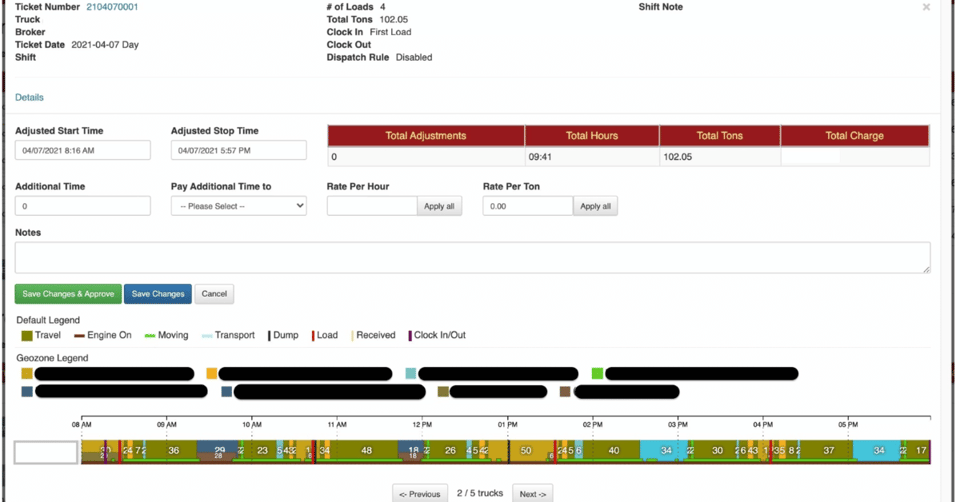
- Create the shift ticket. When the job is over for the day, the foreman ends the shift. FleetWatcher creates the driver's Shift Ticket and sends it for review.
- Apply your pay rules. Customizable rules and pay rates based on equipment class, specific jobs, or activity-based haul types.
- Review the details. Review hours, edit or add line items, adjust time, flag unplanned stops, and include extra charges such as fuel surcharges.
- Approve and export. Approve the ticket through an integrated workflow. Send the driver or broker a PDF summary for confirmation, export a custom CSV for payroll, or pull the data through the API.
The record gets built as the shift happens, across every job and every material, with no paper from the driver. Your team reviews the ticket instead of rebuilding it.
That Midwest contractor built their own CSV template off step five. It loads straight into their accounting system. That is where the eight to ten hours a week came from.
Go Find Your Number
Paper-ticket losses never appear as a line on a financial statement. You have to go get them. Six numbers will tell you how big yours is:
- Truck tickets processed per month
- Percent that need a correction or a follow-up call
- Average time to resolve one exception
- How often hours get rounded or adjusted
- Dollar value of truck-payment corrections
- Days between a completed shift and an approved payment
You are not proving that every paper ticket costs you money. You are finding out how much of your truck spend runs on records nobody can check. At scale, a small exception rate is a large number. One contractor found $50,000 to $60,000 in a habit nobody had thought about.
You Cannot Control What You Cannot Verify
CFOs should not have to choose between paying trucks on time and paying them correctly.
Virtual Shift Tickets build one record per truck from what the truck actually did. Your team reviews it, applies the rates and charges, approves it, and sends it to payroll or the broker. Fewer handoffs. No reconstruction. A straight line from the work to the payment.
If your team still runs on paper truck tickets, schedule time with the FleetWatcher team.