

What does your company construct? Office towers? Luxury homes? Consumer electronics? Whatever your specialty, building a strong safety culture within your organization is just as important as its external product.
The lost time injury rate — sometimes referred to as the incident rate or, more commonly, abbreviated LTIR — is a critical metric that offers insights into the frequency and severity of workplace accidents. It helps identify the effectiveness of your company’s past/current safety practices so you can improve protocol moving forward.
Understanding LTIR
The Occupational Safety and Health Administration requires employers to record different types of workplace accidents that result in:
- Restricted work or a job transfer
- Days away from work
- Medical treatment beyond first aid
- Death
The LTIR calculates the number of injuries or illnesses that prevent employees from performing their regular job duties and require a job transfer or time off work to recover. The LTIR does not include fatal accidents or minor injuries that only require first aid.
How to Calculate LTIR
The formula derived by OSHA to calculate this safety metric is:
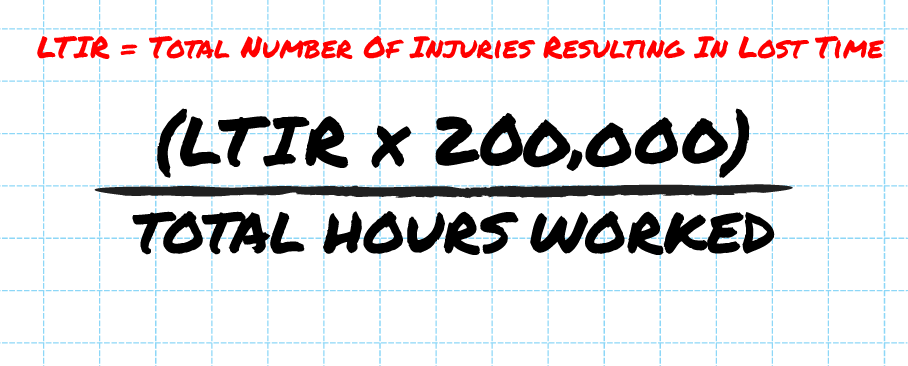
The number 200,000 in the LTIR formula acts as the base for calculating the incident rate for one calendar year. It represents the number of hours 100 full-time employees who use two weeks of vacation would work (40 hours per week for 50 weeks).
How to Track LTIR
Using risk management software is the first step to effectively tracking your company’s LTIR. SafetyReports easily integrates with existing workflows to accurately record and investigate workplace injuries according to OSHA standards.
You can then use this digital data to quickly calculate your LTIR on a regular basis — whether monthly, quarterly or annually — and graph it to identify trends.
It is also a good idea to compare your company’s incident rate to industry averages to gauge if it is good or bad. Companies in the construction and manufacturing industries tend to have the highest LTIRs.
If your incident rate is trending up or is significantly higher than others in your industry, you’ll want to identify areas for improvement and take steps to improve workplace safety. This, in turn, should reduce the number of lost time injuries.
Reducing Lost Time Injuries
Using risk management software is a proven way to reduce workplace injuries. Think of Safety Reports as the framework to building a comprehensive safety culture — it has several features designed to enhance job site safety. Use Safety Reports to:
- Prioritize, conduct, and document safety training
- Empower your crew and encourage communication
- Scan and inspect safety equipment
- Identify potential hazards and implement risk-control measures
Schedule a free demo of Safety Reports and learn about other operational tools from AlignOps.
.png?width=960&length=960&name=Wildfire%20Blog%20Image%20(1).png)

-x2(2732x988).jpg?width=960&length=960&name=warehousemobile-hero-mid-long-bg-x1(1366x494)-x2(2732x988).jpg)