
You run 75 trucks—roughly half company-owned and half brokered.
The orders come in. You line up your drivers. You fill the remaining gaps with brokers. After dozens of texts, emails, and phone calls, tomorrow’s dispatch schedule is set by 3 PM. Every truck is committed.
Then a job gets pushed.
The flaggers are not scheduled. A material site goes down. Rain moves into the forecast, and the paving crew is not going out.
Now you have a carefully built dispatch plan—and it is wrong.
You do not have spare trucks waiting somewhere. Every truck is already promised. Fixing tomorrow means pulling trucks from jobs that expect them and notifying drivers, brokers, foremen, and project teams.
That is not two phone calls. It could be 75.
At 3 PM, you are not making 75 calls. You make the ten that matter most and live with the rest.
The next morning, trucks arrive at a job that no longer needs them while another job runs short. Some brokered trucks may still need to be paid. Production slows, and the schedule starts changing all over again.
The most expensive part? You may already have enough capacity.
Three trucks could be waiting between loads on one job while another job calls in a broker. Without a live view across the operation, you cannot see the opportunity to rebalance your fleet—so you pay for idle capacity and supplemental hauling at the same time.
The Missing Half of Fleet Visibility
Many paving and construction companies can see what their trucks did:
- Where they traveled
- How long they waited
- How many cycles they completed
- When they arrived and departed
What they cannot easily see is how that activity compares with the original dispatch plan.
That gap matters. Without a digital record of what each truck was supposed to do, teams cannot quickly compare planned truck counts, assignments, and schedules with actual fleet activity.
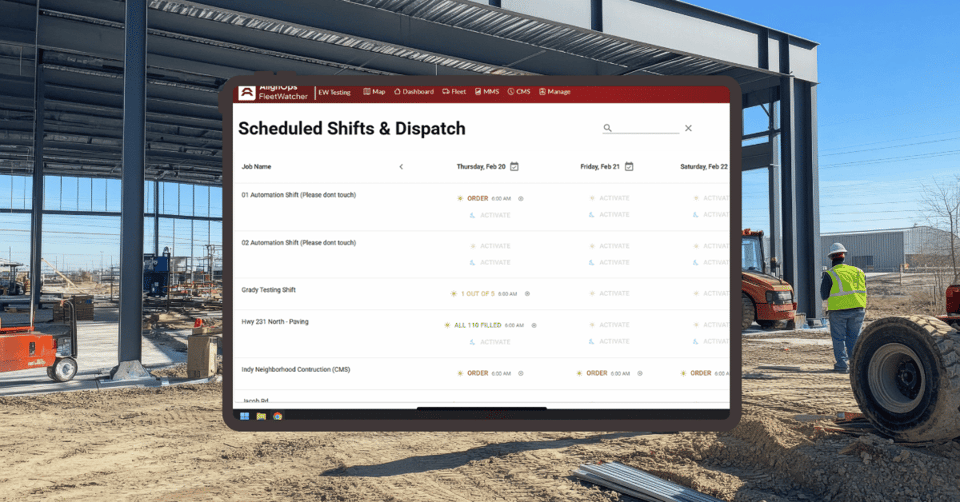
FleetWatcher Dispatch brings the plan and the work together. It records what was requested, which trucks were assigned, and how the schedule changed—giving operational data the context needed to improve future dispatch decisions.
The Cost of Dispatching by Phone, Text, and Spreadsheet
The plan lives in too many places
The original request came by phone. The truck count changed by text. A new start time went out over the radio. Before making a decision, the dispatcher must first reconstruct the latest version of the plan.
Nobody can see every job at once
One job may have trucks waiting between loads while another is short and requesting supplemental hauling. When each job is managed separately, you can pay for idle trucks on one and additional trucks on the other during the same hour.
Schedule changes create a communication chain
Moving one truck can require calls or messages to the driver, broker, foreman, plant, and project team. The more often the schedule changes, the easier it is for someone to act on outdated information.
The operation depends on one person
As the fleet grows, the dispatch process can start depending on the individual who knows where every assignment, request, and change lives. When that person is unavailable, the process becomes difficult for anyone else to manage.
What Construction Fleet Dispatch Software Gives You
One current dispatch plan
Job requests, truck counts, materials, start times, and assignments live in one system. Teams can work from the same version of the schedule instead of piecing it together from separate conversations.
Visibility across every job
See how trucks are assigned across upcoming work. When plans change, dispatchers can identify where capacity may be available before bringing in additional trucks.
Faster schedule changes
Edit or reschedule work where the request and assignments already live. Updated schedules can be distributed without rebuilding the plan or repeating the same change across multiple communication channels.
Planned-versus-actual insight
Compare the dispatch record with actual truck activity. See what was planned, what happened in the field, and where the two did not align.
A repeatable dispatch process
Every job moves through the same workflow, regardless of who is managing the schedule. Dispatch knowledge becomes part of the system instead of remaining in one person’s head.
How FleetWatcher Dispatch Works
Every job begins with a request. In FleetWatcher Dispatch, you can define details such as:
- Number of trucks requested
- Types of trucks needed
- Material being hauled
- Expected cadence
- Scheduled date and start time
That same request then moves through the dispatch process:
- Schedule the upcoming work.
- Define the truck and material requirements.
- Assign trucks and drivers.
- Edit or reschedule the work when conditions change.
- Fulfill the request.
- Distribute the completed schedule.
Your team still makes the operational decisions. FleetWatcher Dispatch keeps the request, assignments, and schedule changes together so those decisions can be communicated and carried out more efficiently.
Calculate What Your Current Dispatch Process Costs
Dispatch inefficiency rarely appears as a single line on a financial statement. It shows up across labor, idle time, supplemental hauling, and production delays.
Start with four questions:
- How many hours does your team spend building and rearranging the schedule each week?
- How often does one job run short while trucks wait on another?
- How much did you spend on supplemental hauling last month?
- How often do trucks arrive after the job plan has already changed?
These numbers can reveal whether your current dispatch process is helping you use the capacity you already have—or forcing you to buy more.
You Are Not Paying for a Disorganized Schedule. You Are Paying for Trucks.
Every hour a truck waits costs money. Every brokered truck added while company-owned capacity sits idle puts additional pressure on hauling margins.
FleetWatcher Dispatch gives paving and construction teams one place to schedule work, assign trucks, manage changes, and compare the dispatch plan with actual fleet activity.
If your dispatch process still relies on calls, texts, spreadsheets, and one person holding everything together, it may be time for a clearer view.
See how FleetWatcher Dispatch can help your team coordinate trucks across every job.
.png?width=960&length=960&name=What%20is%20a%20dvir%20%20(1).png)