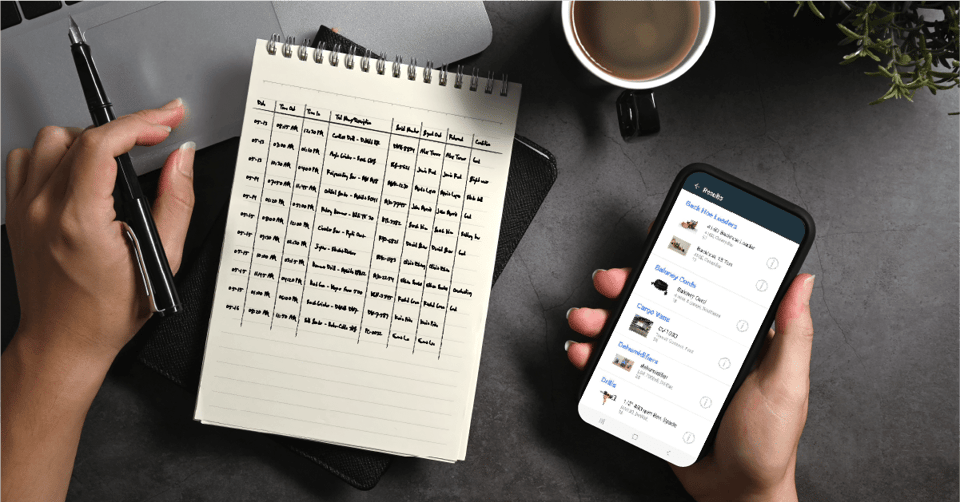
Barcodes are a staple in construction tool check-in and check-out processes — and they’re not going anywhere anytime soon. They’re simple. They’re fast. And when they work, they bring order to even the most chaotic jobsites. But there’s one question that comes up every time contractors consider implementing them: Will they actually hold up?
It’s a fair concern. Tools go through a lot — constant handling, exposure to weather, impact, grease, and daily wear. In many cases, labels peel, fade, or become unreadable over time, disrupting the very system they’re meant to support.
But that hasn’t been the experience for ToolWatch customers. We spoke with Al Derrikson from HB McClure, a ToolWatch customer since 2021, who showed us something most contractors wouldn’t expect: a worn wheelbarrow and hand cart from 2001, still carrying their original ToolWatch barcodes. Despite decades of real jobsite use, the labels were still fully readable and scannable.
And that’s the difference. ToolWatch barcodes aren’t just built to work on day one. They’re built to last through years of jobsite conditions without losing their reliability.
“The wheelbarrow and the hand cart are 2001, and you can still read the tags on these tools here.”
Why ToolWatch barcodes can withstand harsh jobsite conditions
ToolWatch by AlignOps was built by contractors for contractors, which means durability isn’t a nice-to-have — it’s expected. These barcodes were designed specifically for the reality of the jobsite, where tools are constantly moved, used, and exposed to harsh conditions.
That durability starts with how the labels are attached. ToolWatch barcodes are designed to bond securely to a wide range of materials, including plastic, wood, and rubber. Once applied, the adhesive strengthens over time, reaching full bond within 72 hours and becoming a long-term part of the tool itself. This allows the label to stay in place through constant movement, vibration, and handling.
But staying attached is only part of the equation.
These labels are built to remain readable in the same environments your tools operate in every day. They hold up against oil, fuel, solvents, and industrial chemicals without losing clarity. They withstand repeated abrasion and continue to scan accurately. They also perform in extreme temperatures, from freezing conditions to intense heat, without cracking or fading. Even prolonged exposure to sunlight and repeated cleaning doesn’t compromise their performance.
That’s what allows the ToolWatch barcode tracking system to last not just for months, but for years — often for the full lifecycle of the tool.
Types of ToolWatch barcodes
ToolWatch offers three different barcode options, so you can pick what works best for your assets. Here’s your cheat sheet to what we have available:
| Label Type | Material | Attachment Method | Best Use Case |
| Polyester | Durable plastic | Adhesive (stick-on) | Everyday tools |
| Aluminum (Adhesive) | Anodized aluminum | Adhesive (stick-on) | Harsh environments |
| Aluminum (Rivet) | Anodized aluminum | Rivets / screws | Extreme or high-abuse tools |
1. Aluminum labels (adhesive-backed)
For more demanding environments, aluminum labels offer an added layer of durability. These labels are made from anodized aluminum and include a protective coating that helps resist chemicals, heat, and heavy wear. They’re designed for tools that are exposed to harsher conditions and need a label that can maintain readability over time without breaking down.
2. Aluminum labels (rivet-mounted)
In the most extreme environments, adhesive alone may not be enough. That’s where rivet-mounted aluminum labels come in. These labels are physically attached using rivets or screws, creating a secure, permanent connection to the tool. They’re ideal for rough, uneven surfaces or high-impact tools where labels need to stay in place no matter what.
3. Polyester labels (standard option)
Polyester labels are the most commonly used option and serve as the starting point for most contractors. Made from durable material with a protective coating, they use a strong adhesive backing that allows for quick and easy application. They’re best suited for everyday tools with smooth, flat surfaces like metal or plastic. When applied correctly, they provide reliable performance and long-lasting adhesion at a cost-effective price point.
Start Tracking Your Inventory With ToolWatch Barcodes
No matter which ToolWatch barcode you choose, every option is designed to maintain readability and reliability throughout the lifecycle of your assets. Because the goal isn’t just placing a barcode on a tool. It’s creating a tracking system your team can rely on long term — during transfers, maintenance, and every check-in and check-out in between. Want to learn more about ToolWatch barcodes and construction asset tracking? Book a demo to connect with a member of the ToolWatch team.